The Tarpon
Foundered August 26th, 1957
Foundered August 26th, 1957
1,500
Tons Surfaced, 1,990 Tons Submerged
298
feet Length, 25 feet Beam, 15 feet Deep
Owner:
U.S. Navy
Builder: Electric Boat Company, Groton, Connecticut
Foundered under tow August 26th, 1957
Depth 140 feet to the sand
History of the Tarpon
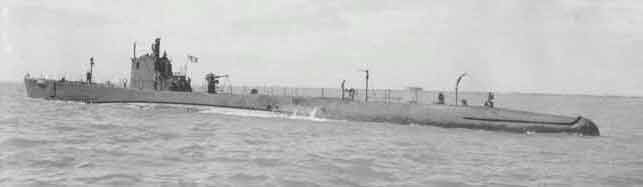
The Tarpon, P-4, (also known by the SS-175 designator) was built by the Electric Boat Company in Groton, Connecticut, and completed on March 3, 1936; one of four boats of her class. Only the Submarine Shark (P-3) was really identical, the other two (Pike & Porpoise) being just slightly shorter and lighter in displacement. More importantly the Shark and Tarpon were the first all welded submarines in the U. S. Navy, the construction technique presently used. The Tarpon was designed for long range patrols and operated in the Pacific Ocean during her entire
operational career,
completing many war patrols against the Japanese during WWII. The Tarpon
sunk a German Raider, the Michel, during one of her Pacific war patrols
with an attack that required 8 torpedoes to send the enemy combatant to the
bottom. This was only sinking of an enemy raider like the Michel by
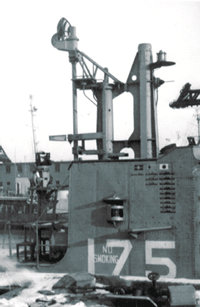
a submarine during the war. The boat is 298'1" in length and 25'1" in beam and she displaced 1,968 Tons submerged. The Tarpon was equipped with Winton Diesel engines that produced 4300 HP for surface use and when submerged she was pushed along by 2,085 HP electric motors made by the Elliott Motor Company. All this horsepower running out the twin screws gave her a surface speed of 19.5 knots and 8.25 knots when underwater. The 5 Officers and 45 Enlisted men that took the Tarpon to war had a great deal of armament to do battle with; six 21" torpedo tubes (including two deck firing tubes), 16 torpedoes, one 3"/50 deck gun and two .50 cal machine guns. These weapons sunk a great number of enemy combatants and shipping as you can see in the photo of the conning tower, taken at the South Boston Navy Yard near the war's end. The Tarpon received seven battle stars for her WWII service.
Maybe the Tarpon knew what she was doing: resting in the sea has to be a better fate than becoming razor blades.
|
|
|
Diving the Tarpon
Diver swims over the top of the Tarpon bow section Notice the anchor on the starboard side. |
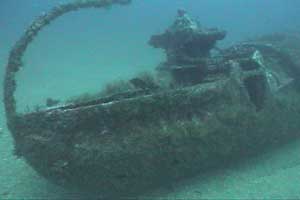
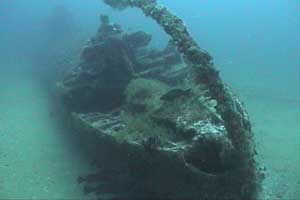
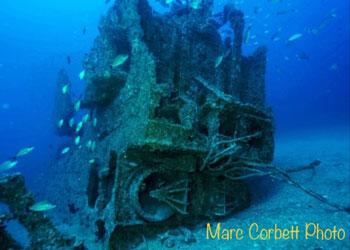
Located near the Proteus wreck, the American submarine Tarpon is a thrilling sight as you descend the anchor line. Much larger than the German U-boats, when the Tarpon comes into view her long hull disappears into the distant haze and her size quickly becomes apparent. She rests on the sand at 140’ with a list to the port side, the uppermost portion of the wreck at 110’ (the bow section) and the stern slightly deeper. Most divers maximize their bottom time by staying up on top of the hull while touring the wreck. This allows a diver to see the majority of the wreck swimming from end to end. Even when the current is running, divers can still cover a great deal of the wreck by pulling themselves along the hull using the exposed ribs and machinery instead of swimming against the current. Navigation is easy on this wreck because the submarine is virtually intact, except for the bow and conning tower, both of which lay in the sand beside the main hull. Many divers visiting the Tarpon for the first time mistake the stern for the bow, because the tapered stern appears to be “the pointy end” and there are no propellers.
For divers unwilling to risk entry into the boat, the Tarpon is still fascinating. The deck has many items of machinery to examine and the submarine makes an interesting photographic subject. |
|
Stern view of the Tarpon looking forward.
Starboard side view of stern. |
The
Tarpon is also known as a site that normally has a good number of
Sandtiger Sharks present on almost all dives. The many times I have
dived the Tarpon in the last several years, there has always been at least
a few seen and many times there are too many to count. On one dive
in the 2010 season, we were at the site very early in the morning and
witnessed something very interesting. Laying on the bottom alongside
the hull at the bow was a group of at least 20 large sandtigers all facing
into the current They were all together in one big pile 3 or 4 deep
and apparently sleeping. It was very much like the behavior of
whitetips or nurse sharks, but to my knowledge, something not seen
before with Sandtigers.
Throughout the diving season numerous large grouper, pompano and other gamefish are seen on this wreck making it a good site for spearfishing as well provided that there are not large numbers of the sharks present. Tarpon is almost always a great dive in good visibility and there is a lot to see. But the depth and the high current sometimes present makes it a challenging site but one that should be visited by any diver with enough skill.
The bow of Tarpon is broken off revealing the outer tube doors |
More information and other photographs of the Tarpon can be found at these sites:
Send mail to
webmaster@divehatteras.com with
questions or comments about this web site.
Copyright © 2003
Last modified:
April 22, 2020
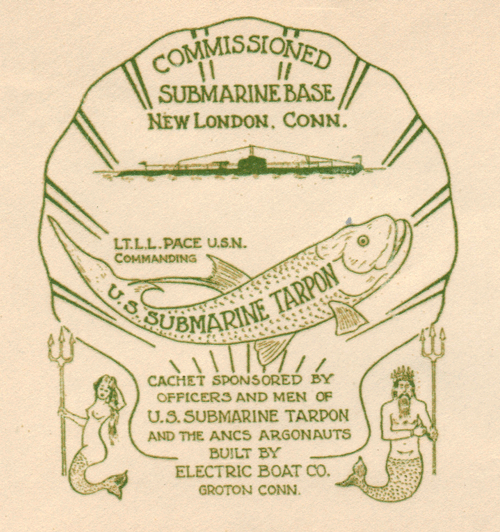 Years after WWII, on August 26, 1957, the Tarpon came to her demise off the Outer Banks while under tow to a
scrap yard in Baltimore, Maryland. She mysteriously took on water during the tow and made her final dive completely unmanned.
Years after WWII, on August 26, 1957, the Tarpon came to her demise off the Outer Banks while under tow to a
scrap yard in Baltimore, Maryland. She mysteriously took on water during the tow and made her final dive completely unmanned.
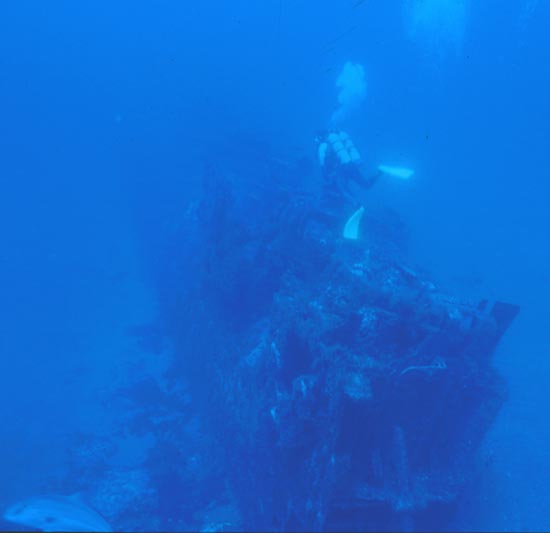
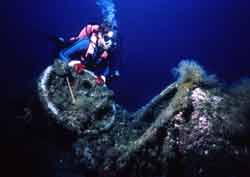 More experienced and adventurous divers can penetrate the dark interior of the intact pressure hull,
through the open hatches of the boat. Many artifacts, such as gauges, lamps, plaques and the like, are recovered from the interior - but don’t be fooled by the
apparent ease of entry; penetration into the Tarpon requires skill, preparation, and proper
equipment as the interior is dark and very, very dangerous.
More experienced and adventurous divers can penetrate the dark interior of the intact pressure hull,
through the open hatches of the boat. Many artifacts, such as gauges, lamps, plaques and the like, are recovered from the interior - but don’t be fooled by the
apparent ease of entry; penetration into the Tarpon requires skill, preparation, and proper
equipment as the interior is dark and very, very dangerous.