 986
Gross Tons
986
Gross Tons
185
feet Length, 38 feet Beam, 18.8 feet Deep
Owner:
Gilbert Transportation Company, Mystic Conn
Builder: M.B. McDonald, Mystic, Connecticut
Depth 103 feet
Location: 11 miles South of Hatteras Inlet
Cause: Foundered after grounding on the Diamond Shoals
Bound for Knight's Key from New York, the wooden four masted Schooner CATHERINE M. MONAHAN, never completed her journey. She sank in 100 feet of water, approximately 14 miles south of Cape Hatteras on August 14, 1910. The vessel was built just six years earlier, in 1904, at Mystic Connecticut, by M. B. McDonald.
Made of oak and fastened with copper/iron fittings, the four masted schooner had beautiful lines which were complemented by a long bow sprit. She was 185 feet long, 38 in the beam and 18.8 in depth, with two decks and a gross registered tonnage of 986 tons, 769 net. The Lloyds registry of 1904 shows her to have a home port of New London, Connecticut, and the owner to have been M. L. Gilbert of Gilbert Transportation Company of Mystic Conn.
It is believed that the Schooner crossed over the Diamond Shoals and struck bottom, creating a leak in her hull and causing her to finally sink several miles to the South of the shoals. When the ship went down, the cargo consisted of many sacks of Portland cement. This cargo, upon contact with the sea water, did what it was intended to, and solidified. The contents of the ships hold has remained as it did when the vessel sank, even though the CATHERINE M. MONAHAN has slowly disintegrated around it.
Captain J. Sheppard, master of the Monahan at the time of the sinking wrote a brief letter of thanks to the Durants Life-Saving Station personnel which was reproduced in the United States Life-Saving Service Annual Report for 1911:
Durant Life-Saving Station, N.C., August 25, 1910
Dear Sirs: I wish to inform you of the kind treatment I have had from the men of this station. We abandoned our vessel, the schooner Catherine M. Monahan, August 24, about 15 miles southeast of Ocracoke Light, in a sinking condition. Signaling us where to land, the lifesaving crew were right on hand to catch hold of our boat and run her up on the beach. In fact, we have had every attention from the keeper and crew of this station.
J. Sheppard, Captain.
Captain Sheppard was not the first to command the Monahan and this was not the first time the schooner faced difficulties off the Hatteras shores. Several years prior, in 1906, the Catherine M. Monahan found herself in a fierce storm while passing this coast under the command of Captain Louis B. Stanton. During the storm one on the ship's crew, Vincent Long the chief engineer, briefly took command of the vessel as he feared for the ship. When Captain Stanton came on deck he "rebuked" Long for this action. This apparently did not set well with Chief Engineer Long as three days later, after the ship had made New York, the two "Sea Dogs" had it out with a lively fistfight, for which they were both arrested. This event was chronicled in a January 9th, 1906 article in the NY Times and is a good read.
 Diving the
Monahan
Diving the
Monahan
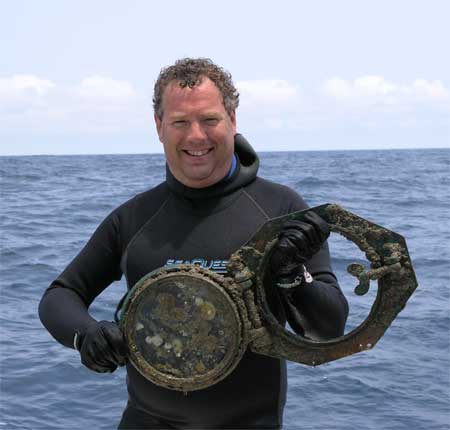
Not much remains of this once proud and beautiful ship except her cargo, some scattered machinery and other small artifacts. Small sections of her wooden hull still remain, thrusting up out of the sandy bottom, leaving one to believe that much more of this vessel must still remain hidden below the shifting ocean bottom. Artifacts such as ceramic pottery, bronze hull spikes and several brass lanterns have been recovered from the sand around the wreck during the 1995 diving season after big storms. Diver Cliff Cason recovered a very nice porthole from the wreck in 2006. Other divers have found items of interest over the years, but artifacts are generally not lying about in plain site.
 The
wreck site is compact and defined mainly by the stacks of cement bags and
barrels which are all cemented together. At the bow end of the wreck is a
windlass, small boiler, and a pile of anchor chain that is still attached to a
large navy style anchor that lays several feet from the main wreckage. It
is at this end of the wreck site that a dive boat should try to anchor as the
rest of the wreck provides only cement bags and remnants of the wooden hull on
which to secure the vessel. The port side of the wreck site provides
the highest relief from the hard sand bottom with stacks of bags rising about 8
to 10 feet then tapering off towards the stern. At the stern end of the
bag pile the keel is often visible along with some hardware that may have
attached the rudder. Along the port side near the stern some metal
artifacts are often visible jutting out of the sand and they appear to have been
mast hardware or some other form of rigging.
The
wreck site is compact and defined mainly by the stacks of cement bags and
barrels which are all cemented together. At the bow end of the wreck is a
windlass, small boiler, and a pile of anchor chain that is still attached to a
large navy style anchor that lays several feet from the main wreckage. It
is at this end of the wreck site that a dive boat should try to anchor as the
rest of the wreck provides only cement bags and remnants of the wooden hull on
which to secure the vessel. The port side of the wreck site provides
the highest relief from the hard sand bottom with stacks of bags rising about 8
to 10 feet then tapering off towards the stern. At the stern end of the
bag pile the keel is often visible along with some hardware that may have
attached the rudder. Along the port side near the stern some metal
artifacts are often visible jutting out of the sand and they appear to have been
mast hardware or some other form of rigging.
There is no evidence of propulsion machinery at the site, no engine, prop shaft or gear. The small boiler at the bow appears to have been used to power the windless and perhaps some pumps. The only photograph known to exist of the ship is shown above.
 The main attraction for divers to this old wooden wreck is the incredible numbers of small creatures inhabiting the cement bag reef.
Countless crabs, shrimps, eels and small tropical fish are always encountered on a dive here, as well as groupers and other such wreck dwellers.
The wreck site often has rays around it but rarely has shark present, however
they have been numerous on some dives. The wreck is rarely dived by large boats and can be difficult to locate due to the limited relief of only 10 feet and lack of large metal machinery, but a dive here is well worth the effort as the visibility is usually very good due to the hard sand bottom which surrounds this wreck site.
The main attraction for divers to this old wooden wreck is the incredible numbers of small creatures inhabiting the cement bag reef.
Countless crabs, shrimps, eels and small tropical fish are always encountered on a dive here, as well as groupers and other such wreck dwellers.
The wreck site often has rays around it but rarely has shark present, however
they have been numerous on some dives. The wreck is rarely dived by large boats and can be difficult to locate due to the limited relief of only 10 feet and lack of large metal machinery, but a dive here is well worth the effort as the visibility is usually very good due to the hard sand bottom which surrounds this wreck site.

