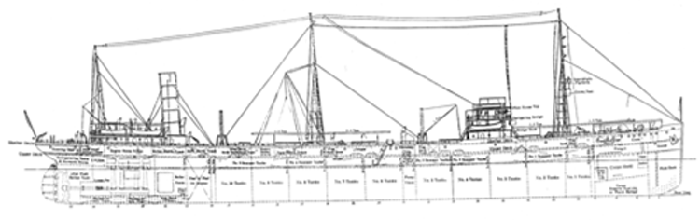
8046
Gross Tons
468
feet Length, 63 feet Beam, 32feet Deep
Owner:
Socony-Vacuum Oil Co. New York, NY (Mobil Oil Corp.)
Builder: New York Shipbuilding Corp., Camden, New Jersey
Depth 90 feet
The month of March, 1942, had been difficult for the men of the Merchant Marine off the coast of North Carolina. There had been an almost endless parade of vessels being torpedoed, shelled, or sunk by mines. The Socony-Vacuum Oil Company (later Mobil Oil) Tanker, Dixie Arrow, became a victim of this terrible month when Kapitanleutant Flachsenberg, skipper of the German Submarine U-71, sent a volley of torpedoes her way.
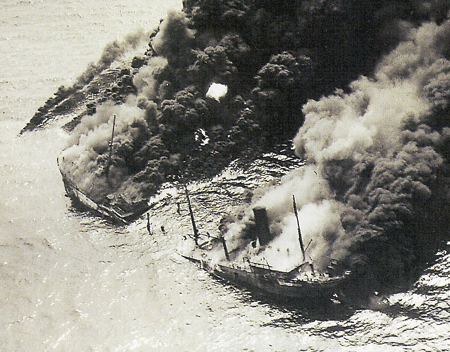 The tanker was struck on the starboard
side at 0858 on the morning of March 26, 1942 by three torpedoes within one minute. The first hit just below the amidships
deckhouse destroying it, and the next two hit slightly abaft this point,
breaking the ship in two. The oil that spurted from the ship was
immediately set aflame sending billowing clouds of smoke thousands of feet into
the sky and enveloping the forepart of the ship in flames. All of the
licensed Deck Officers were lost in the initial explosion and flames. Two of the
four lifeboats were destroyed by the blast and flames, another lifeboat was lost
during the attempt to launch it. Of the 33 man crew, only 22 survived by
using the remaining lifeboat and a raft, several of the men who had been trapped
on the bow section by the raging fire had to jump into the sea and swim for
their lives.
The tanker was struck on the starboard
side at 0858 on the morning of March 26, 1942 by three torpedoes within one minute. The first hit just below the amidships
deckhouse destroying it, and the next two hit slightly abaft this point,
breaking the ship in two. The oil that spurted from the ship was
immediately set aflame sending billowing clouds of smoke thousands of feet into
the sky and enveloping the forepart of the ship in flames. All of the
licensed Deck Officers were lost in the initial explosion and flames. Two of the
four lifeboats were destroyed by the blast and flames, another lifeboat was lost
during the attempt to launch it. Of the 33 man crew, only 22 survived by
using the remaining lifeboat and a raft, several of the men who had been trapped
on the bow section by the raging fire had to jump into the sea and swim for
their lives.
The Able Seaman on duty in the wheelhouse, Oscar Chappell, was awarded the Distinguished Merchant Marine Medal for standing by his post and bringing the ship into the wind, which kept the flames from the men trapped on the bow. By doing this, he turned the flames toward himself in the wheelhouse, thereby giving up his own life to save his fellow crewmen.
Diving the Dixie Arrow
 Today, the Dixie Arrow rests in 90 feet of
water 15 miles south of the Hatteras Inlet. She sits upright on her keel
and even though the torpedo attack broke her in two, both sections lay together
and the wreck is contiguous bow to stern. The most prominent features of
the wreck are the bow and stern areas, with the amidships being a jumble of
beams and steel plates. The bow rises reasonably intact from the forward bulkhead of the number one tank to the bow stem which stands some 30 feet proud
of the sand.
Today, the Dixie Arrow rests in 90 feet of
water 15 miles south of the Hatteras Inlet. She sits upright on her keel
and even though the torpedo attack broke her in two, both sections lay together
and the wreck is contiguous bow to stern. The most prominent features of
the wreck are the bow and stern areas, with the amidships being a jumble of
beams and steel plates. The bow rises reasonably intact from the forward bulkhead of the number one tank to the bow stem which stands some 30 feet proud
of the sand.
The Dixie Arrow has been under the sea many years and the salt water, along with countless storms, has taken their toll on the structure of the ship. When I first dived the tanker in the 1980's, the bow was very intact with most all of the structural beams of the deck intact and all the hull plates solid. Today, the top decks have collapsed into the interior of the bow and all of the structural beams that supported the decks and connected the two hull sides have fallen. Even the strong pillars that supported all this structure have fallen in the last few years. This has allowed the uppermost sections of the hull shell to fall away into the sand on either side of the ship. These hull plates contain a row of about a dozen or so portholes that over the years many divers have worked to retrieve - mostly without success. The bow section has continued to deteriorate and in the past several years a section of the forward most port side has peeled away and a large split is starting at the very stem. The forepeak decks have collapsed almost down to the keel. The shell (hull plating) is also beginning to show corrosion holes between the frames, webs and stringers. All of this foretells of the eventual demise of this once proud tanker. Nothing can stop the deterioration of the salt water, Hurricanes and winter storms.

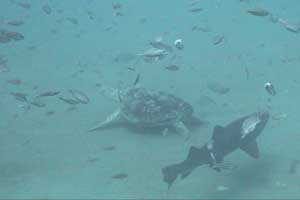
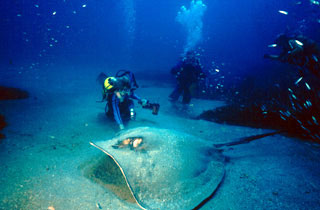
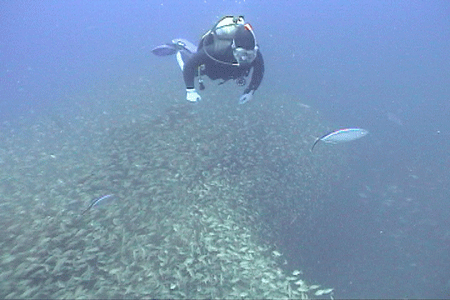
The stern section is every bit as interesting as the bow with the triple expansion steam engine dominating the view here. The engine, which is so large you can swim through it, is sitting upright and towers over the three boilers that are just forward of the engine. On both sides of the engine are the scattered remains of the machinery spaces; pipes, valves and fittings of all size and description. The aft deck house lays many feet off the starboard side of the stern section and is upside down mostly buried in the sand. The majority of the hull shell plating has fallen away with the last few plates still attached to the ship and they clearly define the hull which still rises 10 feet from the sand in most sections. All of this rubble provides excellent habitat for an incredible number of sea creatures. I have spent many dives perched on top of this giant engine watching them cruise past - everything from the smallest tropical fish and shrimp to sharks, rays and turtles pay a visit to the Arrow. She is know as a shipwreck that has a large variety of sea life and usually in great number as well.
Due to her
location and the hard sand bottom surrounding the site, the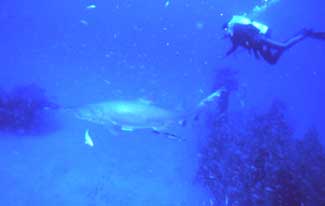 visibility is usually good to excellent and the current most often light.
However, when the Gulf Stream is pushing in close the current can be up to
one knot or more on the surface, but with the relief offered by this wreck it
remains dive able even under conditions of higher current. Being only 15
miles from the inlet we are usually able to make the trip in all but the
worst of sea conditions. Because of these factors and especially the
abundant sea life, the Dixie Arrow
is often one of the most requested dives we do and even after having visited her
many times, she rarely disappoints us.
visibility is usually good to excellent and the current most often light.
However, when the Gulf Stream is pushing in close the current can be up to
one knot or more on the surface, but with the relief offered by this wreck it
remains dive able even under conditions of higher current. Being only 15
miles from the inlet we are usually able to make the trip in all but the
worst of sea conditions. Because of these factors and especially the
abundant sea life, the Dixie Arrow
is often one of the most requested dives we do and even after having visited her
many times, she rarely disappoints us.
Song of the Tanker
By Grantland Rice
This is the song the tanker
sings
As it plows through the waning suns--
"We don't travel on flying
wing
Or know the glory a warship brings
To those who handle her guns.
But we ride on the breath of flaming death
As the oil pours through
our dikes,
Facing our doom in the starless gloom
As the big torpedo
strikes."
This is the story the tankers
tell
As they tackle the poisoned foam--
"Starting our journey we know
too well
We may be facing the Port of Hell
As Charon calls us home.
But we'll still sail through till the end is due
And the final tale is
spun.
And we'll ride the waves that may be our graves
Till the closing
fight is won."
Source: The Years of Peril, Cdr. Arthur Gordon, New York: Socony-Vacuum Oil Co. (Mobil Shipping and Transportation Company), 1954, 1994 (Originally appeared in Socony-Vacuum News, October 1945)
American Merchant Marine at War, www.usmm.org